
Management guideline for rare irAEs (<1% incidence rate) and infusion-related reactions

International guideline (ASCO, ESMO and NCCN) recommendations for other irAEs1-3 ^

^ For detailed guidelines, please refer to original publication

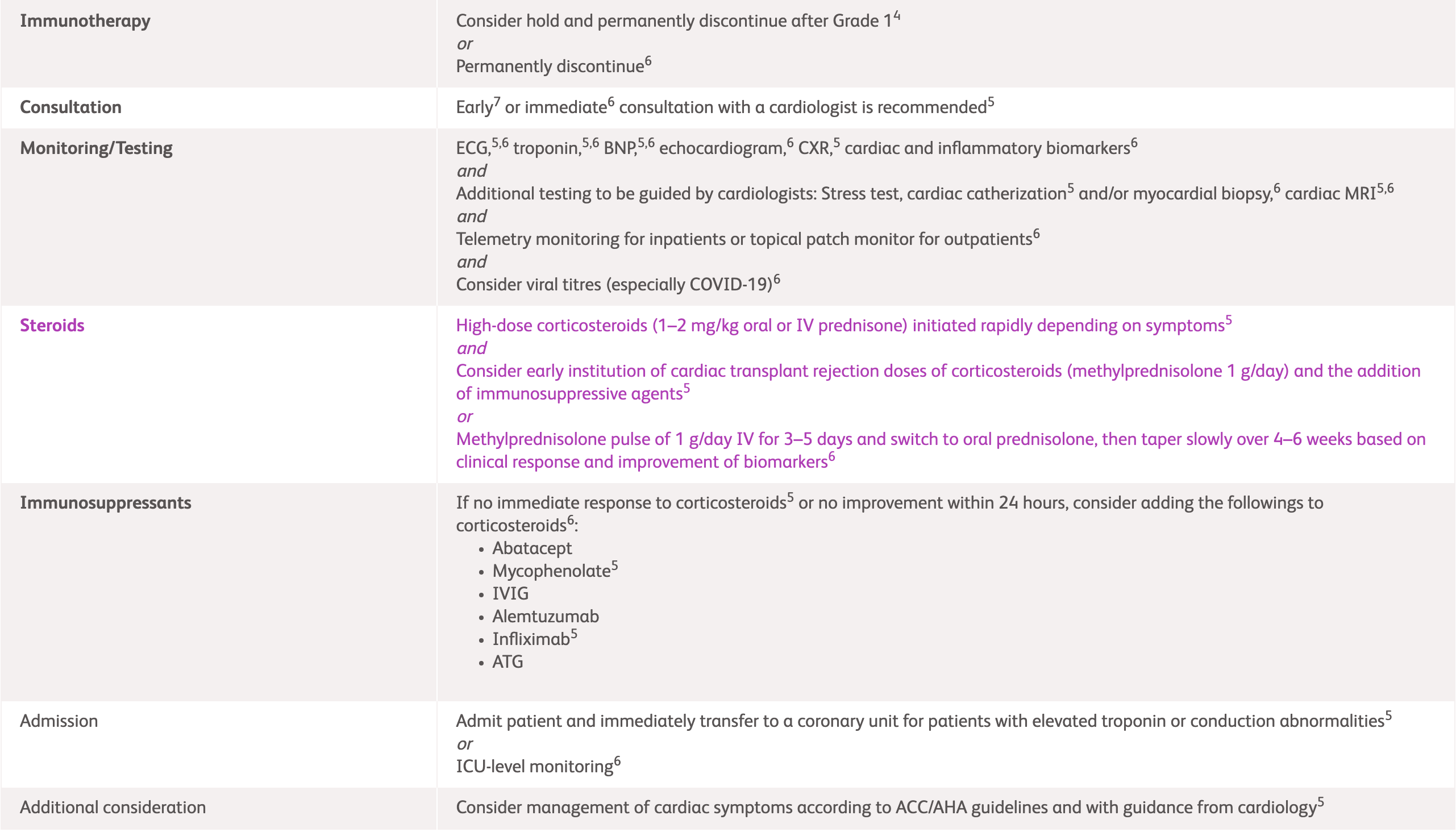
Suspected myocarditis, pericarditis, large vessel vasculitis
Hide Table

  Management Grading/Assessment
Myocarditis
  • Discontinue immunotherapy
  • ICU-level monitoring
  • Temporary or permanent pacing as required
  • High dose steroids (IV methylprednisolone 1g/day) for 3–5 days.
  • If responsive, switch to oral prednisone (1 mg/kg/day) then taper slowly over 6–12 weeks
  • If no improvement within 24–48 hours, consider additional immunosuppression:
    • Abatacept
    • Alemtuzumab
    • Antithymocyte globulin
    • Infliximab
    • IVIG
    • Methotrexate
    • Mycophenolate mofetil
    • Plasmapheresis
  • Immediate cardiology consultation (preferably cardio-oncology)
  • ECG
  • Telemetry monitoring
  • Echocardiogram (if possible with LV strain measurement)
  • Test for cardiac and non-cardiac biomarkers
  • Evaluate for concomitant irAEs, myasthenia gravis, myositis
  • Consider cardiac catheterisation and/or myocardial biopsy
  • Consider viral titres
Pericarditis/Pericardial effusion
  • Consider myocarditis as a contributor
  • If myocarditis is not present, manage as per cardiology guidelines

ECG, electrocardiogram; ICU, intensive care unit; irAEs, immune-related adverse events; IV, intravenous; IVIG, intravenous immunoglobulin; LV, left ventricle; NCCN, National Comprehensive Cancer Network.

Myocarditis, pericarditis, arrhythmias, impaired ventricular function with heart failure, and vasculitis*

Hide Table

Grading Management Assessment
  • All grades warrant workup and intervention
  • ECG
  • Troponin, CPK to rule out concurrent myositis
  • Alternative reasons should be ruled out
  • Elevated troponin should be serially monitored and bring attention to potential myositis, myasthenia, and myocarditis
  • BNP
  • Echocardiogram
  • Chest X-ray
  • Consider: stress test, cardiac catheterisation, cardiac MRI
Grade 1:

Abnormal biomarker testing
No symptoms
No ECG abnormalities
  • Hold immunotherapy and recheck troponin after 6 hours. Consider resuming once normalised or deemed unrelated to immunotherapy
Grade 2:

Abnormal biomarker testing
Mild symptoms
New ECG abnormalities without conduction delay
  • Discontinue immunotherapy
  • Early initiation of high-dose corticosteroids (1–2 mg/kg/day of prednisone, oral or IV depending on symptoms)
  • Admit for cardiology consultation
  • Consider transfer to coronary care unit for those with elevated troponin or conduction abnormalities
  • Consider a pacemaker
  • For patients with no immediate response to high-dose corticosteroids, consider methylprednisolone (1 g/day) and addition of either mycophenolate, infliximab, or antithymocyte globulin
  • Consider abatacept or alemtuzumab in life-threatening cases
Grade 3:

Abnormal biomarker testing
Moderate symptoms or new conduction delay
Grade 4:

Moderate to severe decompensation
IV medication or intervention required
Life-threatening condition

*Treatment recommendations are based on anecdotal evidence and the life threatening nature of cardiovascular complications. Holding checkpoint inhibitor therapy is recommended for all grades of complications. The appropriateness of rechallenging remains unknown. Note that infliximab has been associated with heart failure and is contraindicated at high doses (5 mg/kg) in patients with moderate-severe heart failure.

ASCO, American Society of Clinical Oncology; BNP, B-type natriuretic peptide; CPK, creatine phosphokinase; ECG, electrocardiogram; IV, intravenous; IVIG, intravenous immunoglobulin; MRI, magnetic resonance imaging.

Myocarditis

Hide Table

Grading Management and assessment (first 3 days)
IR-myocarditis Management
  • Treat cardiovascular complications according to cardiology guidelines
  • Hold immunotherapy until diagnosis is confirmed
  • IV methylprednisolone 500–1,000 mg/day for first 3 days
Assessment
  • Cardiac troponin
  • Continuous ECG monitoring; cardiography
  • Cardiac MRI
  • Consider urgent coronary angiography and endomyocardial biopsy if clinically unstable
Management escalation
Uncomplicated IR-myocarditis
  • Troponin reduction by >50% from peak
  • No heart failure, CHB or ventricular arrhythmias at the end of day 3
  • In most cases, permanently discontinue immunotherapy
  • MDT review with oncology and cardio-oncology before restarting immunotherapy

  • Convert to oral prednisolone 1 mg/kg/day with a weekly reducing schedule of 10 mg/week if patient is stable

  • Weekly ECG and cardiac troponin monitoring
Complicated IR-myocarditis
  • Steroid resistant: troponin rising or <50% reduction from peak
  • Haemodynamic instability: heart failure, cardiogenic shock, CHB or ventricular tachyarrhythmias
  • Permanently discontinue immunotherapy
  • Continue IV methylprednisolone 1,000 mg/day

  • Add 2L immunosuppressive: tocilizumab 8mg/kg or MFF
  • 3L options: ATG, alemtuzumab, abatacept

  • Ongoing treatment of cardiac complications
  • Consider mechanical circulatory support if cardiogenic shock
  • Pacing for CHB
  • Beta-blocker therapy for tachyarrhythmias

2L, second-line; 3L, third-line; ATG, antithymocyte globulin; CHB, complete heart block; ECG, electrocardiogram; ESMO, European Society for Medical Oncology; IR, immune-related; IV, intravenous; MFF, mycophenolate motefil; MDT, multidisciplinary team; MFF, mycophenolate motefil; MRI, magnetic resonance imaging.

Hide Table

Grading NCCN2 ASCO1
Grade 1 

Mild transient reaction
Infusion interruption not indicated
Intervention not indicated
  • Continue immunotherapy
  • Consider premedication (acetaminophen, H2 blockers, and diphenhydramine)
Grade 2

Therapy or infusion
interruption indicated but
responds promptly to
symptomatic treatment
Prophylactic medication indicated
for ≤24 hours
  • Continue immunotherapy
  • Treat per institutional guidelines
  • Consider holding or reduce rate of infusion to 50%
  • Consider premedication (acetaminophen, H2 blockers, and diphenhydramine)
  • Consider corticosteroids
  • Consider holding immunotherapy temporarily and reducing rate of infusion to 50% (or per institutional guidelines)
  • Offer symptomatic treatment with antihistamines, NSAIDs, opioids, IV fluids
  • Offer premedication (acetaminophen and an antihistamine per institution guidelines)
Grade 3

Prolonged reaction (not
rapidly responsive to
symptomatic medication
and/or brief interruption of
infusion)
Recurrence of symptoms following initial improvement Hospitalisation indicated for other clinical sequelae
  • Discontinue immunotherapy
  • Treat per institutional guidelines
  • Consider alternate agents in therapeutic class
  • Admit patient
  • Hold immunotherapy, reduce infusion rate to 50% (or per institutional guidelines)
  • Offer symptomatic treatment with antihistamines, NSAIDs, opioids, IV fluids
  • Consider antihistamines and corticosteroid medication
  • Hospitalisation for other clinical sequelae
Grade 4

Life-threatening
Urgent intervention indicated
  • Discontinue immunotherapy
  • ICU-level inpatient care

ASCO, American Society of Clinical Oncology; H2, histamine-2 receptor antagonists; IV, intravenous; ICU, intensive care unit; IV, intravenous; NCCN, National Comprehensive Cancer Network; NSAIDs, non-steroidal anti-inflammatory drugs.

References:

  1. Schneider BJ, et al. J Clin Oncol 2021;39:4073–4126. Available at: https://ascopubs.org/doi/full/10.1200/JCO.21.01440. Accessed April 2025.
  2. National Comprehensive Cancer Network. NCCN Clinical Practice Guidelines in Oncology. Management of immunotherapy-Related Toxicities. Version 1.2025. Available at: https://www.nccn.org/professionals/physician_gls/pdf/immunotherapy.pdf. Accessed April 2025.
  3. Haanen J, et al. Ann Oncol 2022;33:1217–1238. Available at: https://www.annalsofoncology.org/article/S0923-7534(22)04187-4/fulltext. Accessed April 2025.
  4. OPDIVO® (nivolumab) Product Information, BMS Hong Kong.

  5. YERVOY® (ipilumab) Product Information, BMS Hong Kong.

Return to catalogue Back to top